Artificial intelligence (AI) is revolutionizing how businesses process data, make decisions, & deliver services. When combined with cloud-based Linux environments, AI can leverage scalable infrastructure, robust security, and flexible computing resources to operate efficiently and effectively.
Understand how AI functions in these cloud settings helps organizations harness its full potential, from data processing and model training to deployment and real-time analytics.
Introduction to AI in Cloud-Based Linux Environments
Artificial intelligence has transformed the way modern computing environments operate, especially inside large scale cloud infrastructures powered by Linux systems. Over the last decade, businesses, research organizations, streaming platforms, eCommerce companies, healthcare providers, and enterprise technology teams have increasingly relied on AI-driven cloud environments to process data faster, automate operations, and improve digital services.
Most large cloud providers use Linux as the backbone of their infrastructure because of its stability, scalability, flexibility, and resource efficiency. At the same time, AI technologies continue to evolve rapidly, helping organizations manage massive workloads, automate system optimization, and analyze enormous amounts of information in real time.
When AI and cloud based Linux environments work together they create the highly intelligent computing systems capable of handling modern digital demands with greater speed and efficiency. From predictive resource management to automated server scaling and intelligent workload balancing, AI has become deeply integrated into cloud-native Linux operations.
Unlike traditional computing systems that require constant manual management, AI powered Linux cloud infrastructures can dynamically adapt to usage patterns, optimize computing resources, and improve operational performance without extensive human intervention.
Cloud infrastructure
One of the primary reasons Linux dominates cloud infrastructure is its open-source architecture. Organizations can customize Linux distributions according to workload requirements, making it ideal for AI frameworks such as TensorFlow, PyTorch, Kubernetes, Apache Spark, and containerized computing platforms.
Cloud computing itself has evolved significantly. Earlier cloud systems focused mainly on storage and virtualization.
Modern cloud environments now support.
- Intelligent automation
- Distributed AI workloads
- Large-scale data analytics
- Container orchestration
- Edge computing integration
- Real-time machine learning pipelines
This evolution has made Linux-based cloud ecosystems essential for AI development and deployment.
Another important factor is cost efficiency. Linux cloud environments allow organizations to scale AI workloads without investing heavily in physical hardware infrastructure. AI applications can run across virtual machines, containers, & distributed clusters while efficiently utilizing CPU and GPU resources.
The recent years industries such as finance, healthcare, logistics, media streaming, education, and manufacturing have accelerated adoption of AI-powered Linux cloud systems because they support.
- Faster application delivery
- Improved data processing
- Better infrastructure monitoring
- Intelligent automation
- Scalable computing environments
- Continuous service optimization
Modern AI systems also rely heavily on Linux command-line environments for automation tasks, scripting, orchestration, and infrastructure management. Technologies such as Bash scripting, Docker containers, Kubernetes clusters, and Python-based AI workflows operate efficiently within Linux ecosystems.
For example.. administrators commonly use commands.
top
htop
nvidia-smi
kubectl get pods
docker stats
These commands help monitor AI workloads, resource utilization, and container performance in real-time cloud environments.
As organizations continue generating massive volumes of data, cloud-based Linux environments provide the perfect foundation for AI systems that require high-performance computing and scalable infrastructure.
Understanding Cloud-Based Linux Systems
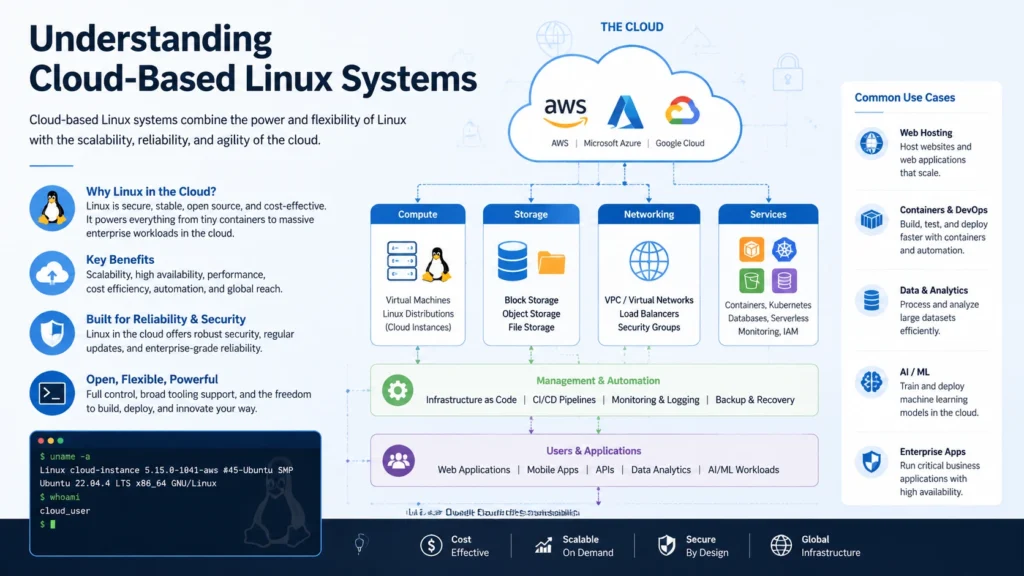
Cloud based Linux systems are virtualized computing environments that run Linux operating systems across cloud infrastructure platforms. These systems allow businesses and developers to deploy applications, manage workloads, store data, & operate scalable services without relying entirely on physical hardware.
Linux became the preferred operating system for cloud environments because it offers.
- Strong system stability
- Lightweight architecture
- Advanced networking capabilities
- Efficient resource management
- High customization flexibility
- Enterprise-grade security management
- Excellent container support
Most public cloud platforms operate heavily on Linux-based technologies. Whether organizations use virtual servers, containers, or orchestration frameworks, Linux remains central to cloud operations.
Infrastructure as a Service (IaaS)
IaaS provides virtual servers, storage systems, and networking infrastructure. Linux virtual machines are commonly deployed for AI processing tasks because they can efficiently handle intensive computational workloads.
Popular Linux distributions used in IaaS environments include..
- Ubuntu Server
- Red Hat Enterprise Linux
- Debian
- CentOS Stream
- SUSE Linux Enterprise
Platform as a Service (PaaS)
PaaS environments simplify application deployment and development. AI developers often use Linux-powered PaaS systems to train machine learning models, deploy APIs, and automate data workflows.
Software as a Service (SaaS)
Many AI-powered cloud applications operate as SaaS solutions running on Linux backend infrastructure. These applications support intelligent analytics, automation systems, and cloud productivity platforms.
Another major component of Linux cloud systems is virtualization. Technologies like KVM and container platforms enable efficient resource allocation across multiple workloads.
Containers have become especially important in AI environments because they package applications with dependencies into isolated units. Docker and Kubernetes dominate this area.
Example Docker command.
docker run -it tensorflow/tensorflow:latest-gpu
This launches an AI-ready TensorFlow container inside a Linux environment.
Kubernetes further enhances scalability by managing container orchestration across distributed clusters.
Example Kubernetes command.
kubectl scale deployment ai-app --replicas=5
This allows automatic scaling of AI applications depending on demand.
Linux cloud systems also support GPU acceleration for deep learning tasks. AI models often require parallel processing capabilities available through GPU-enabled cloud servers.
Modern Linux kernels include advanced scheduling mechanisms that optimize performance for AI workloads balancing.
- CPU allocation
- Memory utilization
- Disk I/O
- Network throughput
- GPU processing
These features make Linux cloud systems highly adaptable for enterprise AI operations.
The Role of AI in Modern Cloud Infrastructure
AI plays a central role in optimizing modern cloud infrastructure improving automation, efficiency, scalability, & operational intelligence. Traditional infrastructure management required administrators to manually monitor systems and allocate resources. AI now enables cloud systems to make intelligent decisions automatically.
One major area where AI contributes is predictive infrastructure management.
AI algorithms analyze server metrics.
- CPU usage
- Memory consumption
- Disk performance
- Network traffic
- Workload demand
analyzing historical patterns, AI systems can predict future resource requirements and automatically optimize infrastructure allocation.
for example, cloud environments can automatically scale Linux-based application servers during periods of increased demand and reduce unused resources during low activity periods.
This process improves..
- Operational efficiency
- Infrastructure performance
- Energy optimization
- Cost management
- Application responsiveness
AI also enhances observability inside cloud-native environments. Modern monitoring systems use machine learning models to identify unusual performance behavior and optimize infrastructure health management.
AI-powered observability platforms monitor.
- Application latency
- Container health
- Service dependencies
- Resource bottlenecks
- Database performance
Linux environments support this process through powerful logging and monitoring frameworks.
- Prometheus
- Grafana
- Elastic Stack
- Fluentd
Example Linux log analysis command..
journalctl -xe
AI systems can process these logs in real time to identify infrastructure trends and operational anomalies.
Another important role of AI in cloud infrastructure is automated workload orchestration. Kubernetes environments increasingly use AI-driven scheduling systems that intelligently place workloads across clusters for maximum efficiency.
AI also improves cloud storage optimization by automatically identifying..
- Frequently accessed datasets
- Archive candidates
- Storage balancing opportunities
- Performance bottlenecks
Distributed cloud environments, AI helps optimize network traffic routing and latency reduction. This becomes especially important for global applications that serve millions of users simultaneously.
Modern AI-enabled cloud infrastructures can also improve energy efficiency in data centers. Intelligent resource scheduling helps reduce unnecessary compute utilization while maintaining performance standards.
As cloud infrastructures continue growing in complexity, AI becomes essential for maintaining operational stability across large Linux-based environments.
Key AI Technologies Used in Linux Cloud Environments
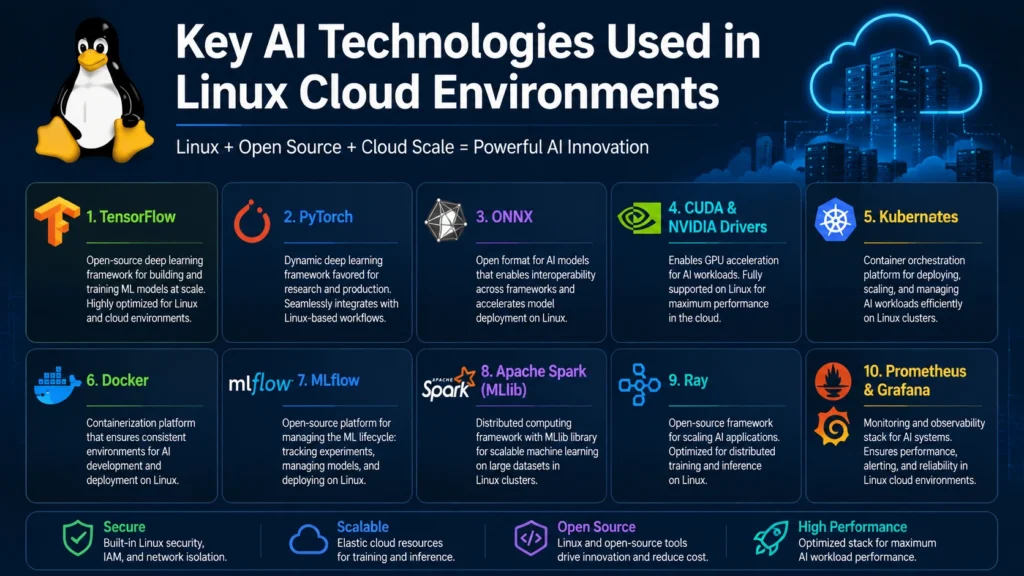
Several advanced AI technologies operate inside cloud-based Linux ecosystems. These technologies work together to automate infrastructure management, process data, and support intelligent computing systems.
Machine Learning Frameworks
Machine learning frameworks are among the most important technologies used in Linux cloud environments.
Popular frameworks include..
- TensorFlow
- PyTorch
- Scikit-learn
- Apache MXNet
- Keras
These frameworks allow developers to train AI models using distributed cloud resources.
Example TensorFlow installation command..
pip install tensorflow
Linux systems provide excellent compatibility for AI libraries because most frameworks are designed primarily for Unix-like environments.
Containerized AI Platforms
Containers help package AI applications efficiently across cloud environments.
Docker remains widely used for AI deployments because it ensures consistent runtime environments across development and production systems.
Example Docker build command..
docker build -t ai-model-app .
Kubernetes further improves scalability by orchestrating AI containers across distributed Linux clusters.
GPU Computing
AI workloads often require high-performance parallel processing. GPU acceleration enables faster training and inference for machine learning models.
Linux cloud environments commonly support..
- NVIDIA CUDA
- ROCm platforms
- GPU virtualization
- Multi-GPU orchestration
Example GPU monitoring command.
nvidia-smiDistributed Data Processing
AI systems process enormous datasets. Distributed computing technologies help Linux cloud environments handle large-scale analytics efficiently.
Popular technologies..
- Apache Spark
- Hadoop ecosystems
- Kafka streaming platforms
- Dask distributed computing
Example Spark startup command..
spark-submit ai-processing.py
Automation and Orchestration
Automation plays a major role in AI cloud environments.
Linux automation technologies..
- Ansible
- Terraform
- Jenkins
- GitOps pipelines
These platforms automate infrastructure provisioning, application deployment, and system configuration management.
Natural Language Processing
NLP technologies help AI systems analyze and process human language data.
Linux cloud environments support NLP frameworks.
- Chat systems
- Content analysis
- Voice processing
- Search optimization
Edge AI Integration
Modern Linux cloud systems increasingly support edge computing integration. AI workloads can now process data closer to devices instead of relying entirely on centralized infrastructure.
This reduces latency while improving performance for real-time applications.
Machine Learning and Data Processing in the Cloud
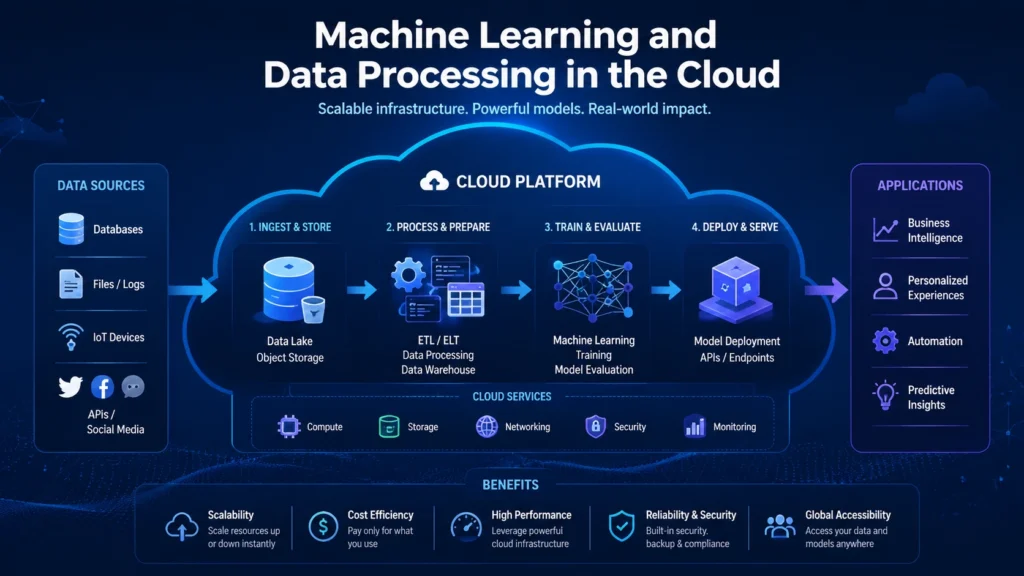
Machine learning relies heavily on cloud infrastructure because AI models require enormous processing power, scalable storage, and distributed computing resources.
Linux cloud environments provide the ideal foundation for machine learning pipelines due to their flexibility and resource efficiency.
Machine learning workflows typically involve.
- Data collection
- Data preprocessing
- Model training
- Model validation
- Deployment
- Continuous optimization
Each stage requires significant computing capabilities.
Cloud-based Linux systems enable organizations to process structured and unstructured data at large scale.
Structured data may include.
- Databases
- Transaction records
- Operational metrics
Unstructured data includes.
- Images
- Audio
- Video
- Documents
- Sensor information
Linux cloud environments efficiently handle both categories using scalable distributed processing systems. data engineers commonly use Python within Linux environments for machine learning operations.
Example Python environment setup..
python3 -m venv ai-env
source ai-env/bin/activate
Machine learning pipelines often integrate with cloud storage services and distributed databases for faster access to training datasets.
Cloud GPU clusters dramatically accelerate deep learning model training. Tasks that previously required weeks can now complete within hours using scalable Linux-based GPU infrastructure.
AI data processing systems also rely on orchestration frameworks to automate workflows.
Popular pipeline technologies include.
- Kubeflow
- Apache Airflow
- MLflow
These systems help automate
- Data ingestion
- Training jobs
- Monitoring
- Deployment cycles
Real-time analytics has also become increasingly important. Streaming AI systems process live data from applications, devices, and enterprise platforms continuously.
Linux cloud infrastructures support this
- Kafka streaming
- Real-time inference engines
- Event-driven architectures
Organizations benefit from faster decision-making, predictive insights, and intelligent automation.
Benefits of Integrating AI with Cloud-Based Linux
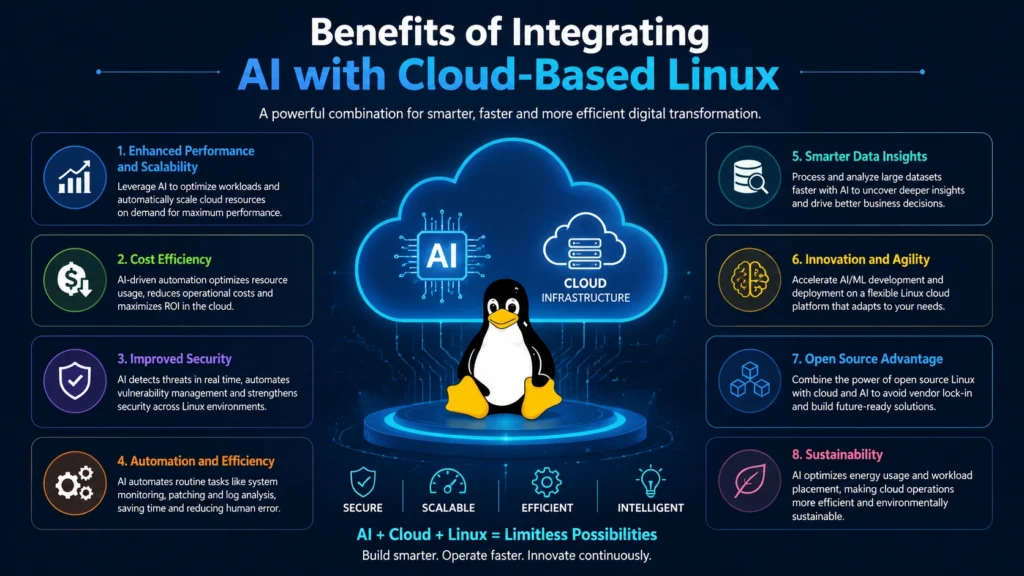
Integrating artificial intelligence (AI) with cloud-based Linux environments has become a transformative approach for modern businesses and developers. combining the flexibility & scalability of Linux-powered cloud infrastructure with the advanced analytical and predictive capabilities of AI, organizations can streamline operations, accelerate innovation, & make smarter data-driven decisions.
This integration allows for efficient processing of large datasets, automated management of workloads, and seamless deployment of AI-driven applications without the constraints of traditional on-premises systems.
As a result, companies can leverage cost-effective, scalable, and secure solutions while unlocking the full potential of intelligent computing in the cloud.
Scalability
AI workloads often fluctuate dramatically. Linux cloud systems allow organizations to scale computing resources dynamically according to workload demand.
This ensures efficient resource utilization while maintaining performance.
Cost Efficiency
Cloud infrastructure reduces the need for expensive on-premise hardware investments.
Organizations pay only for resources they use, improving operational flexibility.
Automation
AI enables intelligent automation across Linux cloud-based systems.
Automation helps manage
- Resource allocation
- Infrastructure optimization
- Application deployment
- Performance monitoring
Performance Optimization
AI systems continuously analyze operational metrics and optimize infrastructure performance in real time.
this improves
- Processing speed
- System responsiveness
- Resource balancing
Flexibility and Open-Source Innovation
Linux provides exceptional customization capabilities. Organizations can adapt environments according to workload requirements while benefiting from extensive open-source ecosystems.
Faster AI Development
Linux cloud platforms accelerate AI experimentation and deployment providing
- Preconfigured environments
- GPU acceleration
- Container orchestration
- Scalable infrastructure
Improved Reliability
AI-powered monitoring systems help reduce downtime by identifying operational issues before they impact services.
Global Accessibility
Cloud-based Linux environments systems allow teams worldwide to access AI environments securely and collaborate efficiently.
Challenges and Considerations for AI Deployment
Deploying AI in cloud-based Linux environments offers tremendous opportunities, but it also comes with a unique set of challenges and considerations. Organizations must navigate issues such as data privacy, infrastructure scalability, model accuracy, and the complexities of integrating AI into existing workflows.
Additionally, the high computational demands of AI workloads, coupled with the need for continuous monitoring and maintenance, can pose significant operational hurdles.
Understand these challenges is crucial for planning successful AI initiatives, mitigating risks, & ensuring that AI solutions deliver reliable, ethical, and impactful results in real-world environments.
One major challenge is infrastructure complexity.
AI systems often require
- Distributed clusters
- GPU orchestration
- High-speed storage
- Scalable networking
Managing these environments requires specialized expertise.
Another challenge is data management. AI applications generate enormous datasets that require efficient storage architecture and optimized processing pipelines.
Resource optimization also becomes critical. Poorly configured AI workloads may consume excessive compute resources, increasing operational costs.
Organizations must carefully monitor
- CPU utilization
- GPU allocation
- Memory usage
- Storage performance
Model optimization is another important consideration. Large AI models require tuning to improve efficiency and reduce latency.
Linux administrators frequently use performance-monitoring commands..
htop
iostat
vmstat
These tools help monitor infrastructure health.
Another consideration involves interoperability between AI frameworks, cloud-based platforms, and enterprise systems. Containerization helps address compatibility issues, but organizations still require standardized deployment strategies.
Compliance and governance also play important roles in enterprise AI operations. Organizations must maintain responsible data management practices and transparent operational controls.
Continuous monitoring becomes essential because AI models may require periodic retraining and performance validation.
Real-World Applications and Use Cases
AI in cloud-based Linux environments is not just a theoretical concept it is already powering a wide range of practical applications across industries. From automating complex business processes and enhancing cybersecurity to enabling predictive analytics and personalized customer experiences, AI technologies are transforming how organizations operate in the cloud-based.
leveraging the scalability, flexibility, & reliability of Linux-based infrastructure, businesses can deploy AI solutions more efficiently and at a lower cost. Exploring real-world applications and use cases helps illustrate the tangible benefits of AI, demonstrating how it solves specific challenges and drives innovation in diverse sectors.
Healthcare Analytics
Healthcare organizations use AI cloud systems.
- Medical imaging analysis
- Patient data processing
- Predictive healthcare insights
- Research acceleration
Streaming Platforms
Media streaming services rely on AI-powered Linux infrastructures.
- Recommendation engines
- Video optimization
- Content delivery balancing
- Audience analytics
Financial Services
Financial platforms use AI cloud-based systems.
- Risk analysis
- Transaction monitoring
- Customer insights
- Market forecasting
Retail and eCommerce
AI improves customer experiences through.
- Product recommendations
- Inventory forecasting
- Personalized shopping experiences
- Demand prediction
Manufacturing and Industrial Automation
Industrial environments use AI cloud systems.
- Predictive maintenance
- Production optimization
- Supply chain management
- Quality monitoring
Smart Cities and Transportation
AI-powered Linux cloud-based infrastructures support.
- Traffic optimization
- Urban analytics
- Smart infrastructure monitoring
- Intelligent transportation systems
Scientific Research
Research institutions use cloud-based AI environments.
- Climate modeling
- Genomics research
- Space simulations
- High-performance computing
Future Trends: AI and Cloud Linux Environments
The future of AI in cloud-based Linux environments looks increasingly advanced and intelligent.
One major trend is autonomous infrastructure management. AI systems are evolving toward self-optimizing cloud environments capable of dynamically managing workloads without extensive manual oversight.
Edge computing will also continue expanding. More AI processing will occur closer to devices to reduce latency and improve responsiveness.
Another trend involves serverless AI architectures. Developers increasingly deploy AI applications without directly managing underlying infrastructure. AI-enhanced Kubernetes orchestration will further improve workload scheduling and resource balancing.
Quantum-inspired computing research may eventually influence Linux cloud architectures for advanced computational workloads. Sustainability is another growing focus. AI systems will help optimize energy usage across cloud data centers through intelligent resource management.
Multi-cloud and hybrid cloud-based strategies will continue expanding as organizations seek greater flexibility and resilience.
AI-powered observability platforms will become more sophisticated, offering deeper operational insights and predictive infrastructure intelligence.
Linux will remain central to these advancements because of its adaptability, open-source innovation, and enterprise scalability.
Conclusion: Harnessing AI for Cloud Innovation
AI and cloud-based Linux environments now form the foundation of modern digital infrastructure. Together, they enable organizations to process massive amounts of information, automate operations, optimize performance, and deliver scalable intelligent services.
Linux provides the reliability, flexibility, & scalability required for demanding AI workloads, while cloud-based infrastructure offers the distributed computing power necessary for machine learning and advanced analytics.
As AI technologies continue evolving, cloud-native Linux ecosystems will become even more intelligent, automated, & performance-driven. Organizations that embrace these technologies can improve operational efficiency, accelerate innovation, and build more adaptable digital infrastructures for the future.
The combination of AI, Linux, and cloud computing is no longer just an emerging trend. It has become a core component of modern enterprise technology, driving the next generation of scalable computing environments and intelligent digital transformation.